
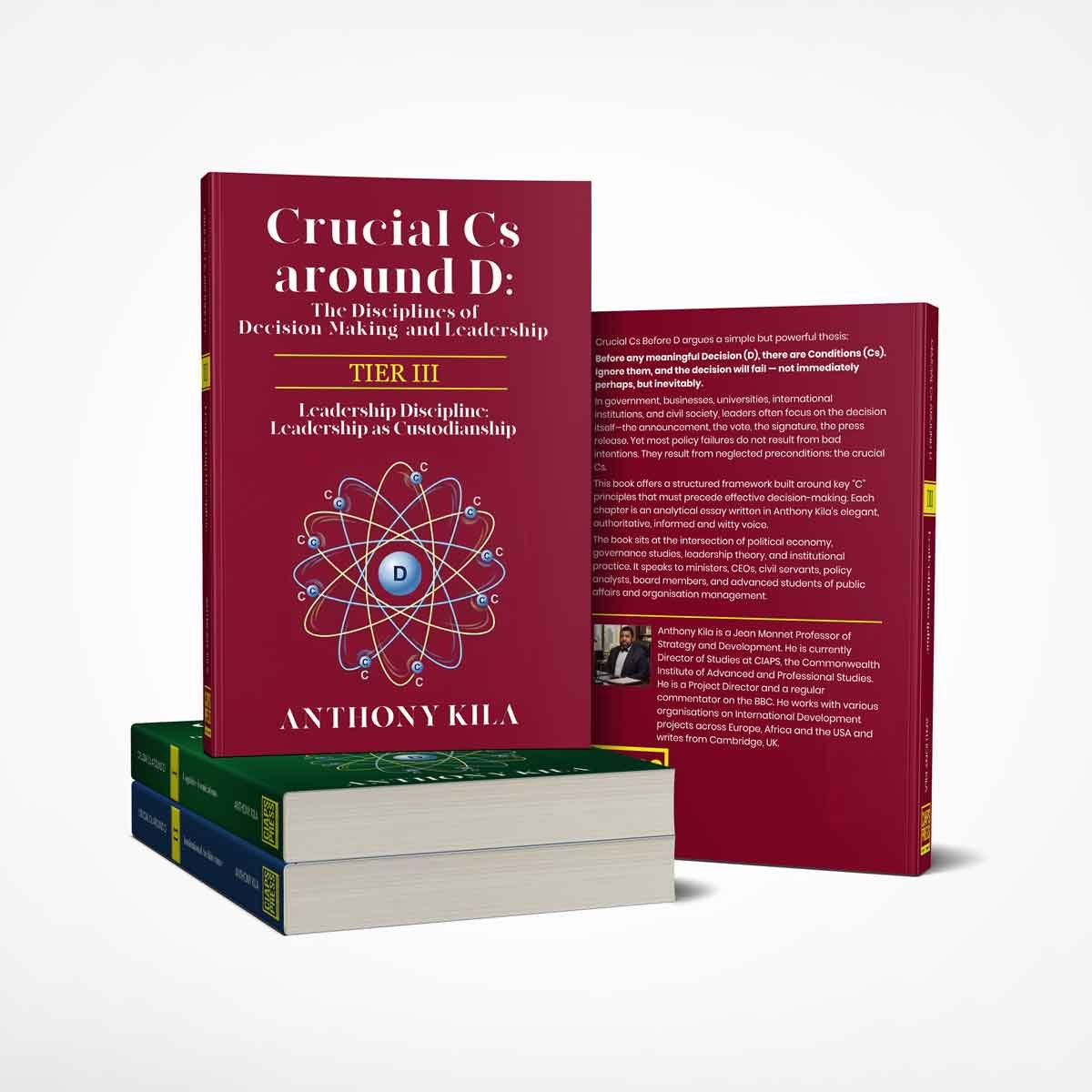
Description
Decisions do not exist in isolation. They are made by people entrusted with responsibilities that extend beyond themselves.
At the heart of every important decision stands a leader, but around that leader lie the crucial Cs—the disciplines of character, credibility, commitment, consistency, courage, conscience, and custodianship that determine whether leadership serves a purpose greater than personal ambition.
This third volume argues that leadership is not primarily about power, position, or popularity. It is about stewardship. Leaders are custodians of institutions, resources, values, relationships, and futures, which they temporarily inherit and are obliged to leave stronger than they found them.
Drawing on philosophy, leadership studies, governance, history, and practical experience, Leadership as Custodianship explores the moral and professional disciplines that distinguish enduring leaders from transient office-holders.
This third volume in the Crucial Cs Around D series shows that the ultimate test of leadership is not merely the decisions leaders make, but the trust they preserve, the institutions they strengthen, and the legacy they leave.
Leadership is not ownership—it is custodianship.
Why do intelligent, well-intentioned leaders so often make decisions that unravel later? Why do policies fail despite expert advice, careful planning, and decisive action? And why do organisations repeatedly pay the price for choices made by leaders who “knew better”?
In the Crucial Cs around the D series, Anthony Kila challenges the most enduring myth of leadership: that good decisions are primarily a matter of decisiveness. Drawing on history, economics, law, management, cultural studies and psychology, the books advance a quieter yet more demanding claim—that decisions succeed or fail long before they are announced and long after those who made them have moved on.
Instead of offering formulas or motivational slogans, these books present a disciplined approach to decision-making centred on a set of interconnected foundations—the Crucial Cs—that must be in place before making any serious decision. These include character, consideration, consultation, commonsense, connectedness, consistency, constraint, and consequence. Each is examined not as a virtue to be admired but as a discipline to practise.
Through a series of insightful essays, Anthony Kila examines how decisions are shaped, distorted, or reinforced by leaders’ thinking, the institutions they operate within, and the time horizons they respect or ignore. Drawing on real-world examples from public policy and organisational life, as well as insights from diverse civilisations across Africa and Asia, from Athens to London, the books show that excelling in one aspect of leadership cannot compensate for neglect in another, and that many failures stem not from ignorance but from poor integration.
At its core, Crucial Cs before D are books about judgement, the ability to balance conflicting demands, resist premature certainty, and make decisions with an awareness of long-term consequences. They contend that leadership is demonstrated not by speed, confidence, or boldness, but by restraint, preparation, and a serious attitude towards time.
Written in an elegant, authoritative, and quietly provocative voice, the books speak directly to leaders in government, business, and complex institutions, yet remain accessible to thoughtful general readers. They do not promise easy answers. Instead, they offer something rarer: a framework for making decisions more deliberately, governing more responsibly, and building systems that endure.
As the books remind us in the closing pages, “leaders announce decisions; history judges preparation”.



Reviews
There are no reviews yet.